VGGT-Ω: 3D Reconstruction in a Single Forward Pass
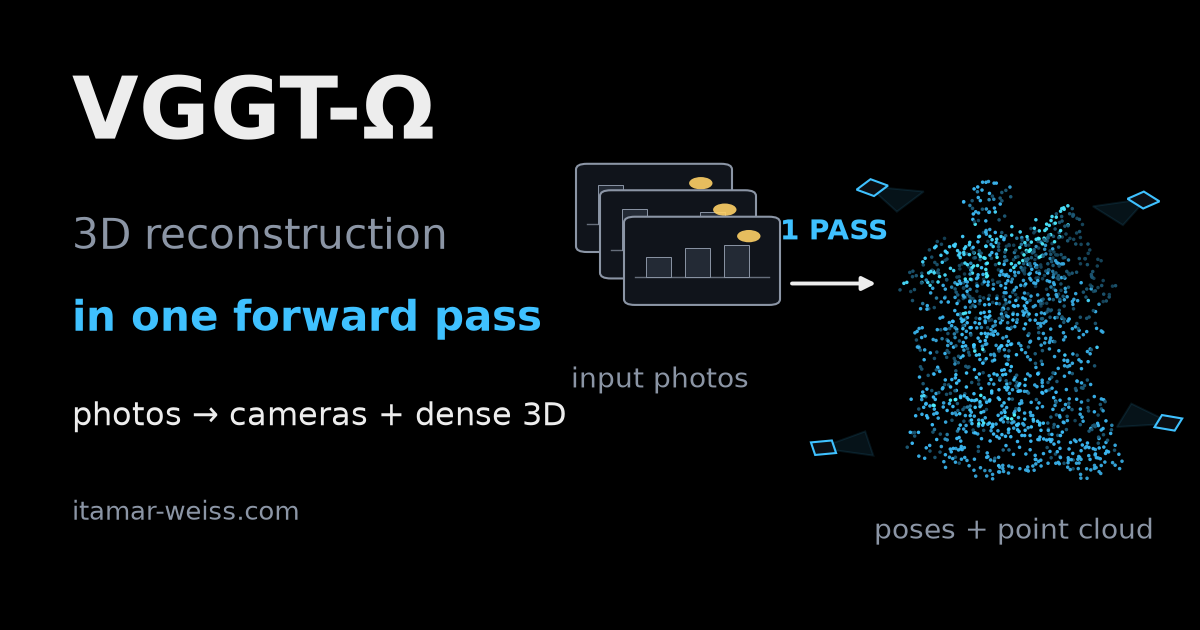
For most of two decades, turning a pile of photos into a 3D scene meant running an optimizer. You'd feed a few dozen images into COLMAP, walk away, and come back to find it had matched features, guessed where every camera was, and slowly nudged all of it into agreement. It worked, it was accurate, and it was the thing you reached for. It was also slow, fragile, and prone to just... giving up on a scene with too few textures or too many repeated windows.
The part that made me want to write this post is how completely that has flipped. The strongest of the new feed-forward methods — VGGT-Ω (VGGT-Omega, May 2026, from the same Oxford-VGG / Meta AI team behind VGGT) — takes those same photos and hands you the cameras and the dense 3D geometry in a single forward pass of a neural network, in about a second, with no optimization loop at all. No bundle adjustment, no global alignment, no walking away.
Before the how, here's the whole shift in one clip — the old iterative loop grinding toward an answer next to VGGT-Ω snapping the scene into place in one pass (a stylized re-enactment of both processes, not real solver output):
This post is the explanation I wish I'd had for how we got from one to the other: what the old methods did, why each new idea replaced the last, and what exactly VGGT-Ω changed to make reconstruction something you scale like a language model instead of something you tune like an optimizer.
What "reconstruction" actually has to recover
Start with the goal, because everything downstream is a different bet on how to reach it. You have a handful of photos of a scene. You want two things back:
- Where each camera was — its position and orientation, plus its focal length (the extrinsics and intrinsics).
- Where every surface point is — a dense 3D geometry of the scene, usually as a depth map per image or a point cloud in one shared coordinate frame.
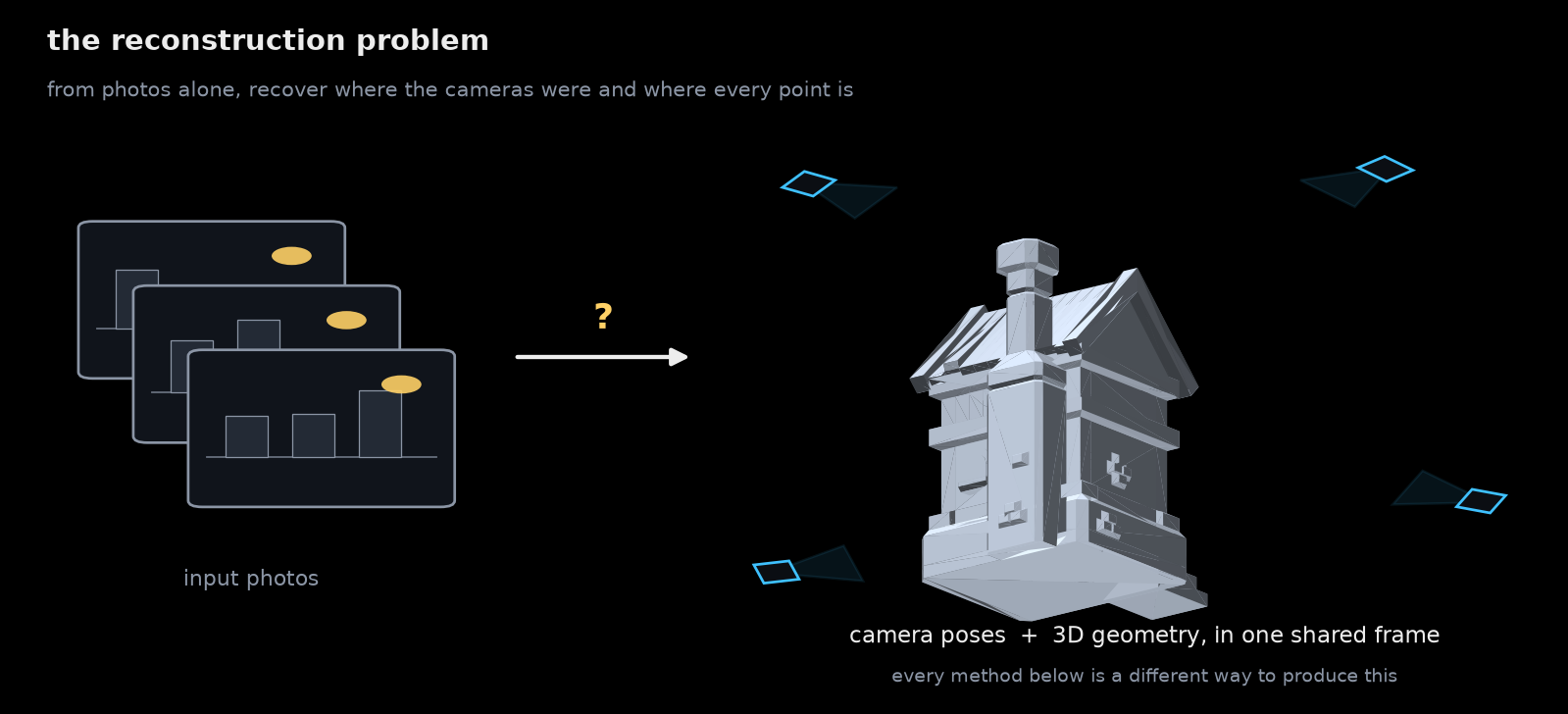
The catch is that these two unknowns are entangled. You can't place the points without knowing where the cameras were, and you can't pin down the cameras without knowing which points in different images are the same point. Every method in this post is a different way to break that chicken-and-egg loop.
The old way: match, then optimize
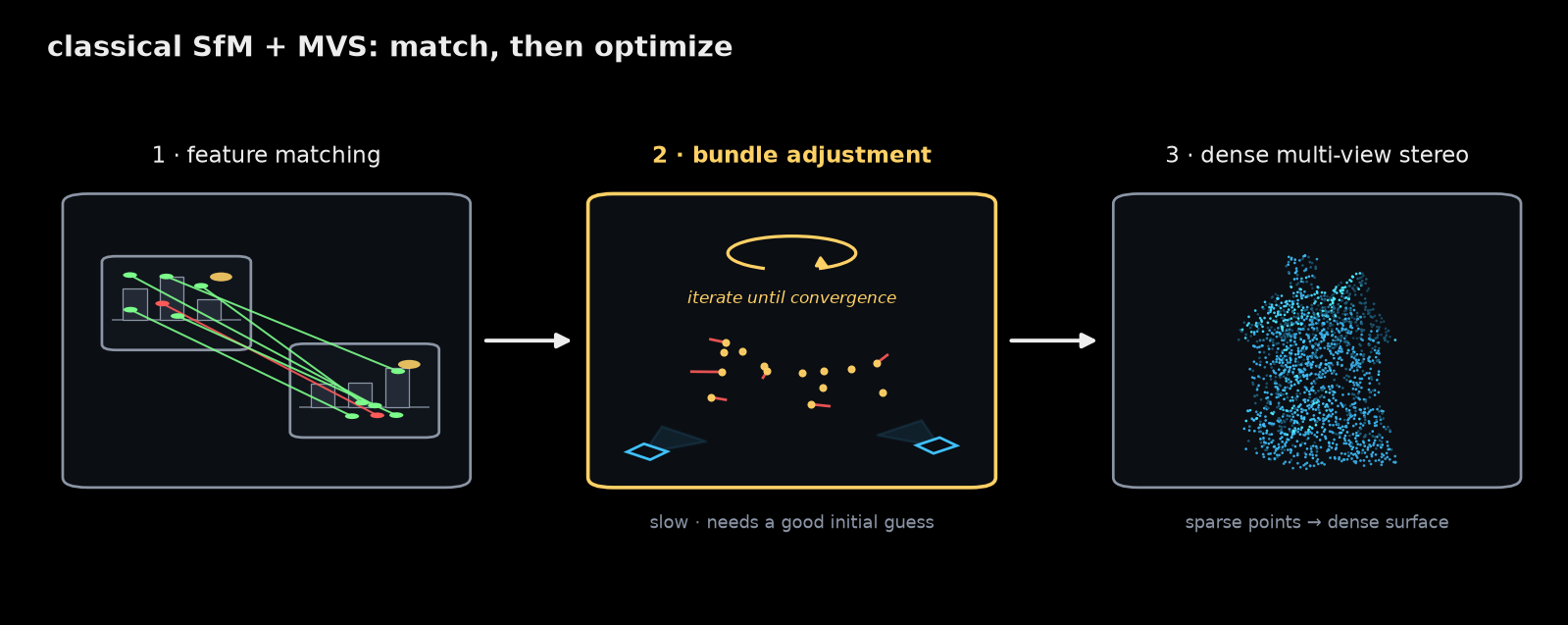
Classical Structure-from-Motion (SfM), of which COLMAP is the canonical implementation, breaks the loop by brute force and iteration:
- Detect and match features across every pair of images — find the same corner, the same poster edge, in photo after photo.
- Triangulate and bundle-adjust — guess camera poses and 3D points, then run bundle adjustment: a big non-linear least-squares optimization that jointly nudges every camera and every point until the 3D points reproject as close as possible to where they were actually seen.
- Densify with multi-view stereo to go from a sparse set of matched points to a dense surface.
Be clear about what this pipeline gets right, because it's a lot. When the capture is good, bundle adjustment is astonishingly precise — on well-conditioned scenes it pins camera angles down to hundredths of a degree, which is why photogrammetry and mapping still run on it. And it's interpretable: the reprojection residual tells you not just the answer but how much to trust it.
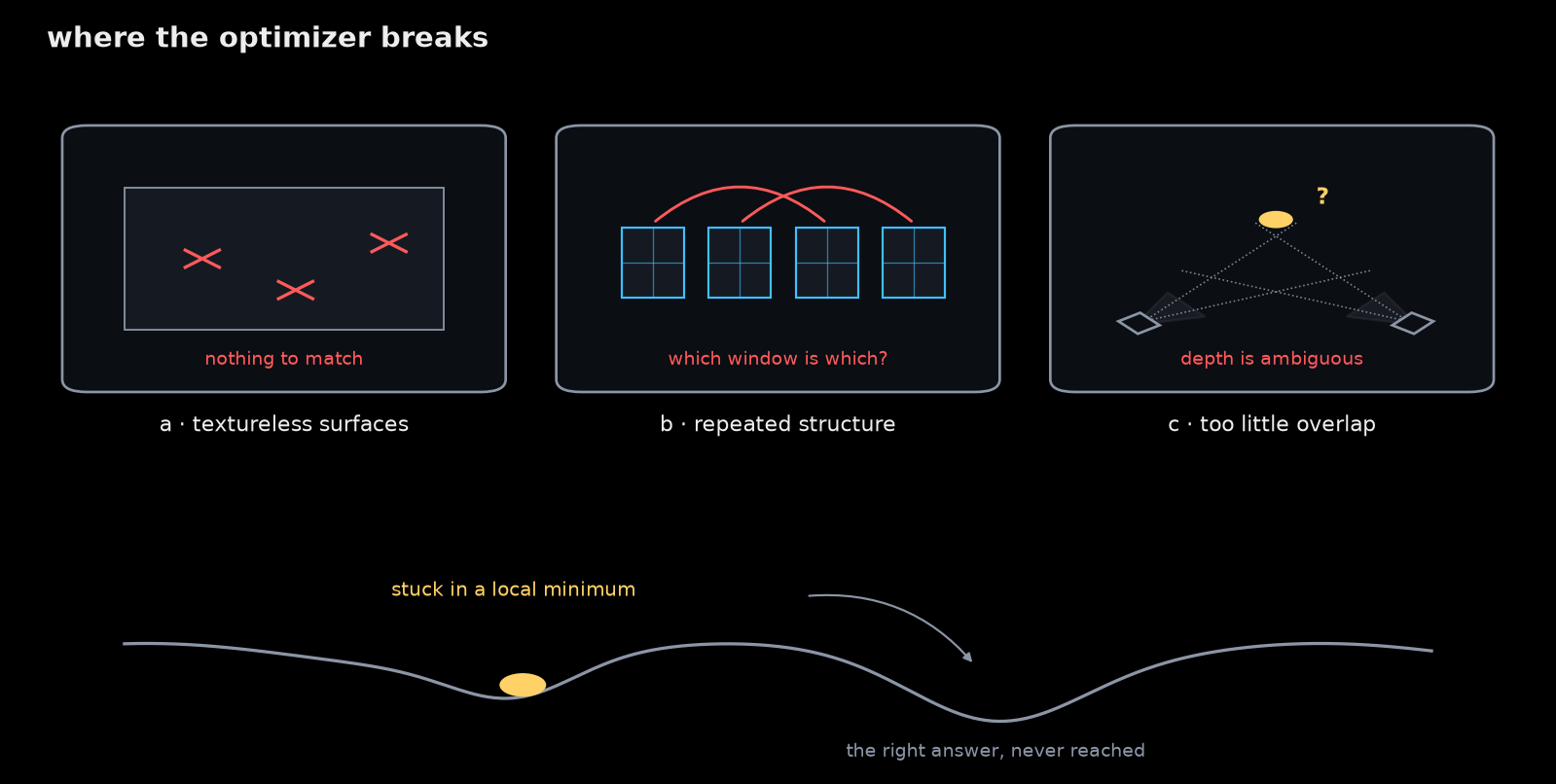
Bundle adjustment is also the problem. It's an iterative optimizer, so it's slow — minutes to hours for a real scene — and it's only as good as its starting guess. Give it a textureless wall, a hall of repeated windows, or too few overlapping views, and the matches go wrong, the optimization walks into a bad local minimum, and the whole reconstruction collapses. For twenty years the research went into making that optimization more robust.
VGGT-Ω's lineage went the other way: what if you never optimize at all, and just predict the answer?
DUSt3R's bet: regress the geometry instead of solving for it
The turn came from DUSt3R (2024). Its idea is
almost cheeky: take two images, feed them to a Vision Transformer, and have it
directly output a pointmap for each — an image-shaped grid where every pixel
holds its (x, y, z) position in a shared 3D frame. No feature matching, no bundle
adjustment, no camera intrinsics required as input. The network has seen enough scenes
during training that it simply regresses plausible geometry.
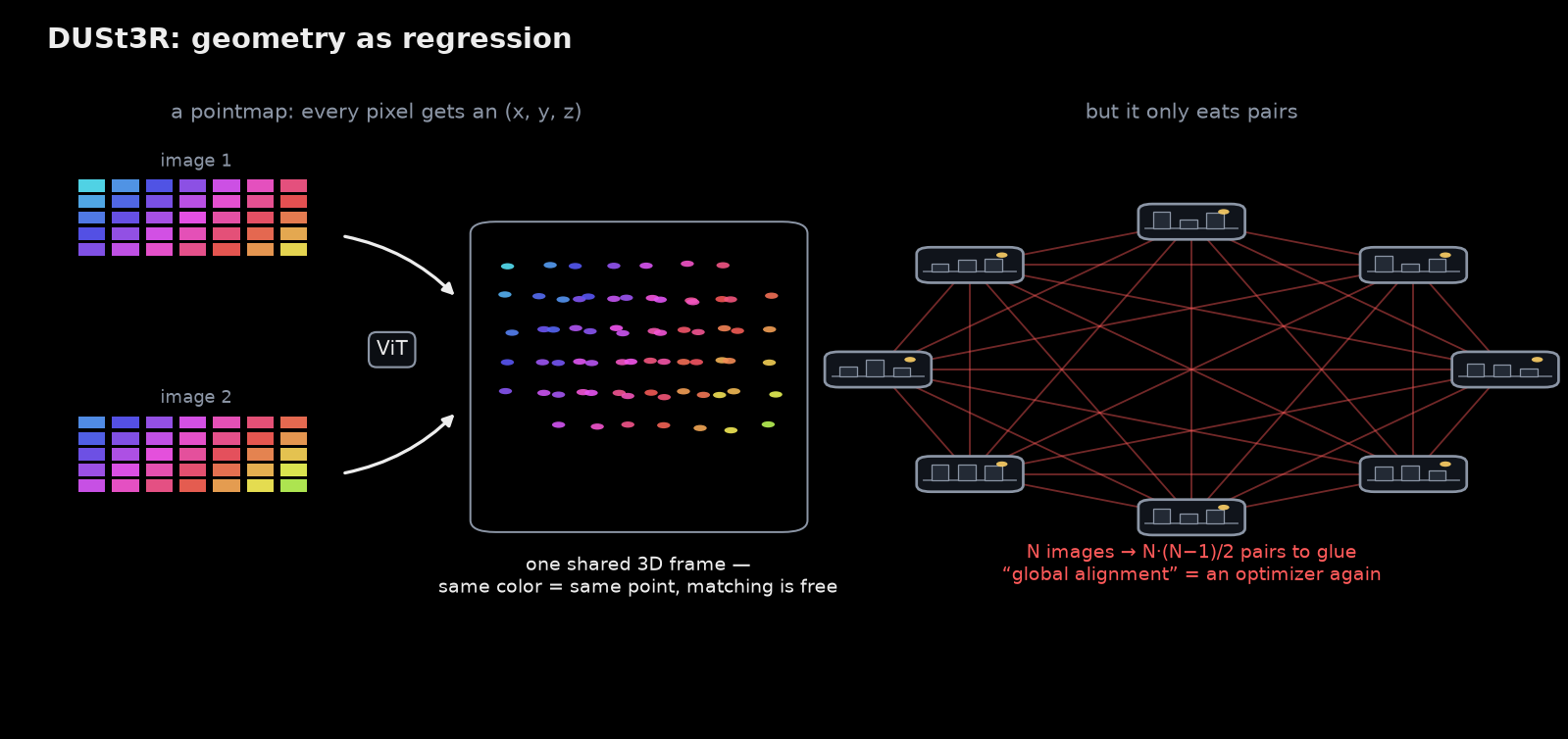
Because both pointmaps live in the same coordinate frame, matching and pose estimation fall out almost for free — the network has effectively already decided which points correspond. And where SfM needs many overlapping, well-textured views before it can even start, DUSt3R happily works from just two images with extreme viewpoint changes, the exact regime that kills feature matching. It was a genuine paradigm shift: reconstruction as regression, not optimization. MASt3R sharpened it with a dedicated matching head for metric accuracy.
But there's a structural weakness hiding in "take two images." Real scenes have dozens or hundreds. DUSt3R handles that by processing pairs and then stitching them together with a global alignment step — which is, quietly, an optimizer again, and one whose cost grows with the number of pairs. So it traded bundle adjustment for a smaller optimization, but didn't escape it.
VGGT: do the whole scene in one pass
VGGT — Visual Geometry Grounded Transformer, the CVPR 2025 best paper — closed that gap. Instead of pairs plus gluing, it ingests all the views at once and predicts everything jointly in one feed-forward pass: camera parameters, depth maps, dense pointmaps, and even point tracks. No global alignment step, because there are no pairs to align — the whole scene is reasoned about together.
The architecture is worth seeing, because VGGT-Ω is best understood as a surgical edit of it:
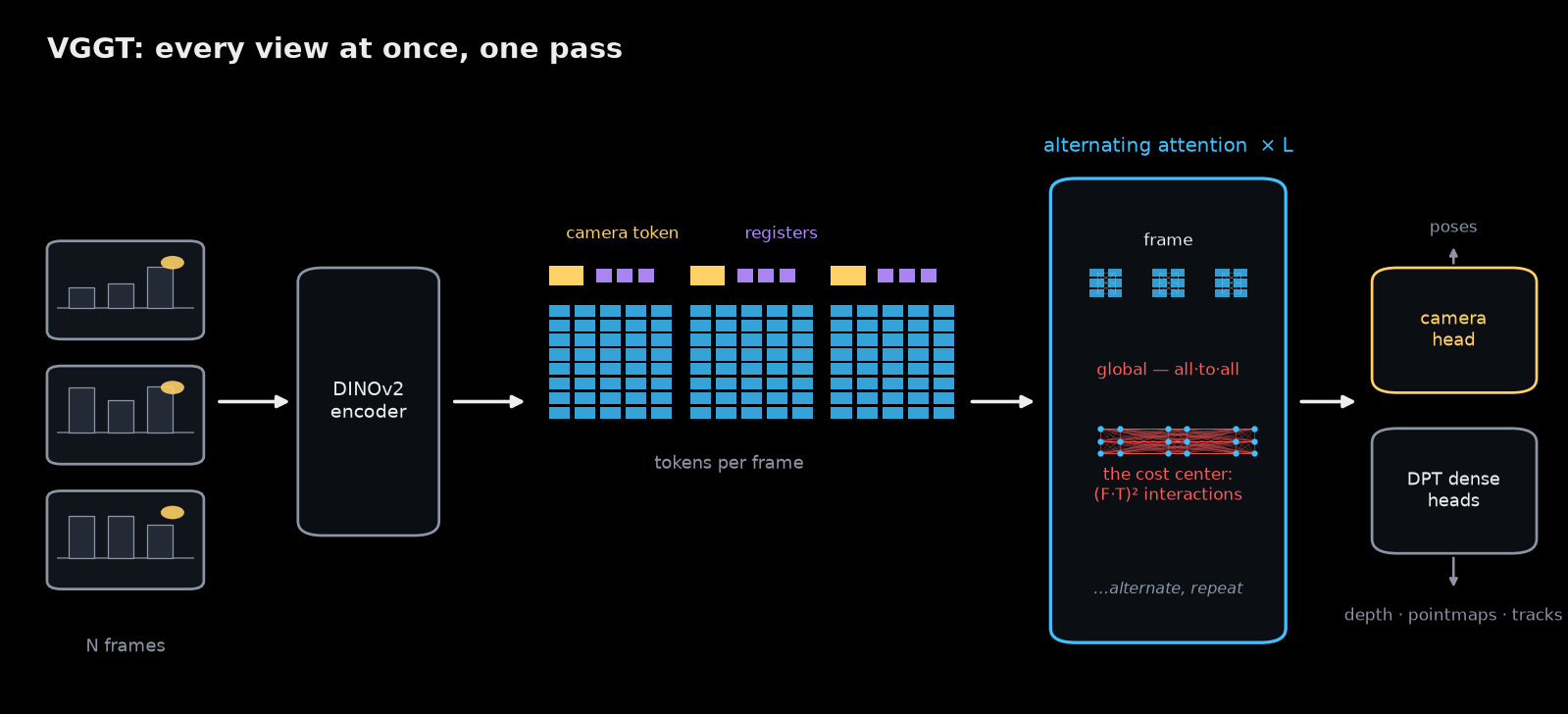
Three pieces to hold onto:
- A DINOv2 encoder turns each image into a grid of tokens, and each frame gets a handful of extra tokens riding along: one camera token that will carry that view's pose, plus a few register tokens — spare tokens with no pixel of their own. (Registers were introduced into vision transformers because ViTs kept hijacking random patch tokens to stash global information; giving them dedicated scratch tokens fixed it. File that away — it becomes the main character shortly.)
- Alternating attention is the core trick: layers alternate between frame attention (tokens attend only within their own image) and global attention (every token attends to every other token across every frame). Frame attention keeps each image coherent; global attention is what lets the network reconcile all the views into one consistent 3D world.
- Prediction heads decode the refined tokens — a camera head that iteratively refines poses, and heavy DPT (dense prediction transformer) heads for the per-pixel depth, pointmaps, and tracks.
It reconstructs a scene in under a second and beat the optimization-based methods it replaced. It was, rightly, a big deal.
The wall VGGT hit
Look back at that global-attention block, because it's where VGGT ran out of room.
Global attention is all-to-all, so its cost grows quadratically. If you have F
frames and T tokens each, every global-attention layer relates F·T tokens to all
F·T others — an (F·T)² blowup. Double the frames and you roughly quadruple the
compute of that step. That's fine for a handful of images and brutal for hundreds. On
top of that, the DPT heads' high-resolution convolutional layers eat a
disproportionate share of GPU memory — not because they hold many parameters, but
because training has to store their huge activation maps. And the whole model is capped
by how much labeled 3D data exists to train on — which is not much, because
ground-truth geometry is expensive to capture.
Here's the observation that opens the door: when the VGGT-Ω team visualized VGGT's global attention maps, they found them mostly sparse — the overwhelming majority of token pairs barely exchange anything. All-to-all attention was paying full price for connectivity the network wasn't using.
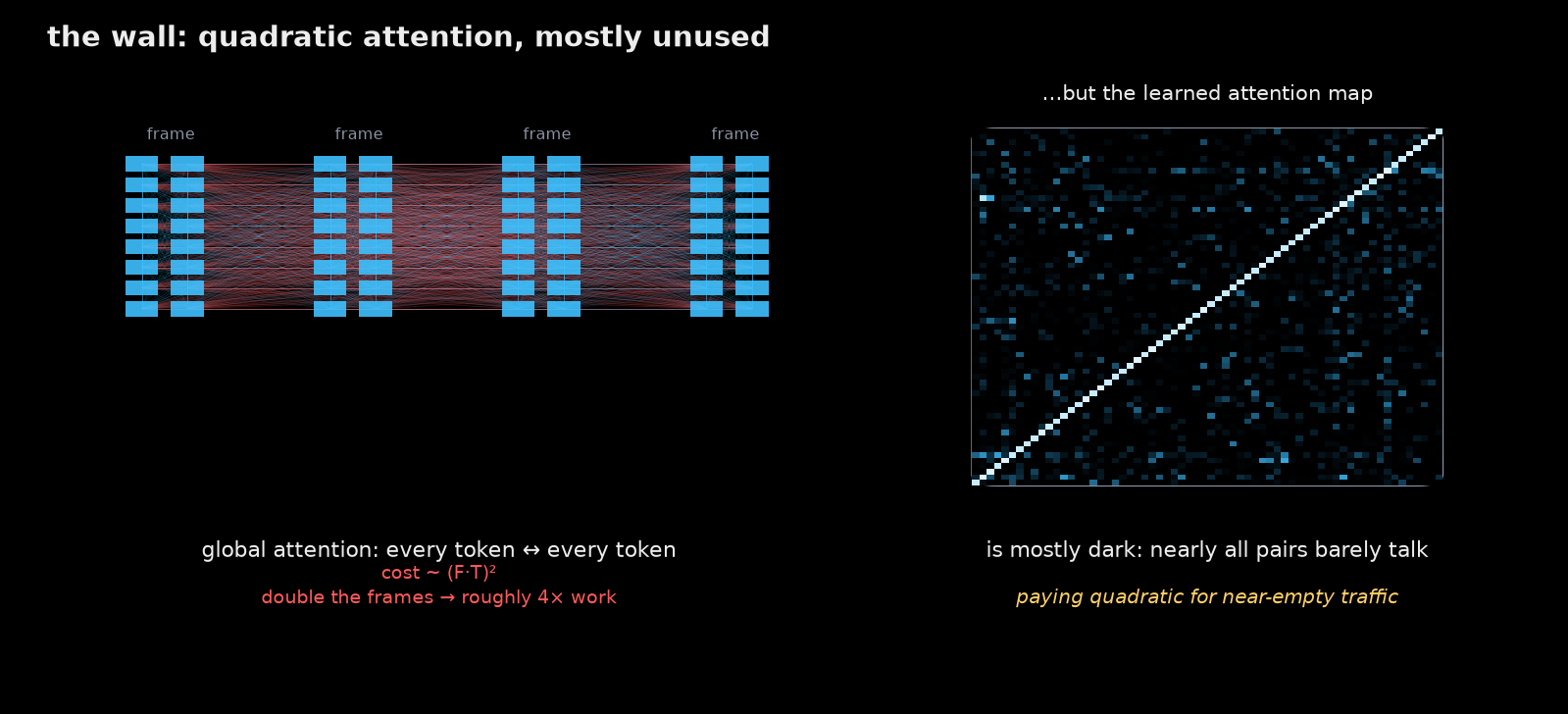
So the question VGGT-Ω set out to answer wasn't "can we predict geometry in one pass" — VGGT already did that — but "can we make that pass cheap enough to scale it like we scale everything else in deep learning: bigger model, more data."
VGGT-Ω's three moves
VGGT-Ω makes three changes, and they compound: together they cut 70% of the GPU memory during training, which is precisely what lets everything in the next section happen.
1. Register attention. Remember those spare register tokens each frame carries (sixteen scene tokens; in the released code, the camera token rides with them through this block)? VGGT-Ω promotes them from passengers to couriers. In a register attention layer, only this tiny scratch-token set talks across frames — the image tokens don't attend across frames at all. The cross-frame conversation happens between each frame's register/camera couriers, and then, in the next frame-attention layer, each frame's couriers brief their own image tokens on what the rest of the scene looks like. Information still flows globally — it just travels through a two-step relay instead of a full mesh.
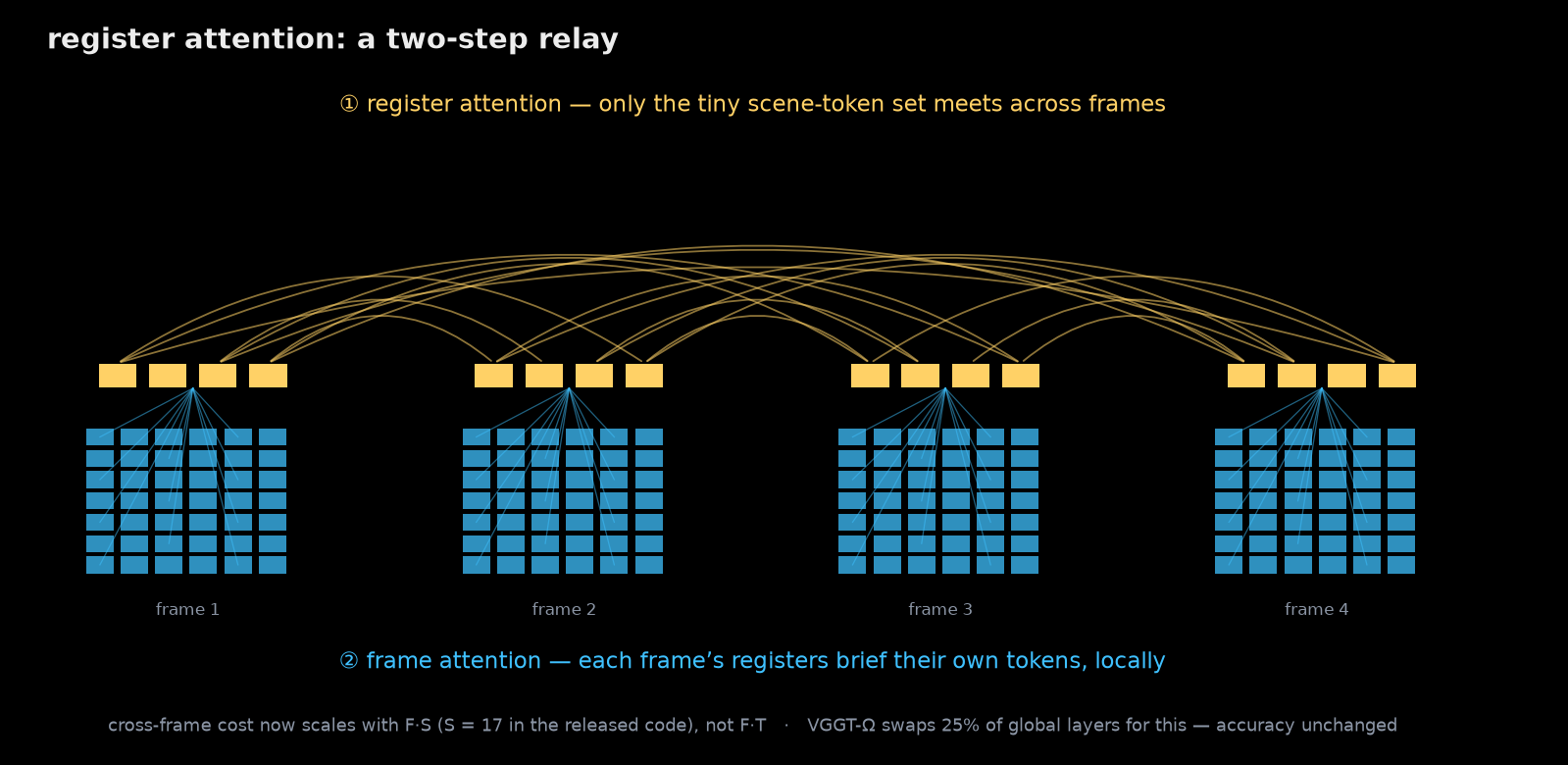
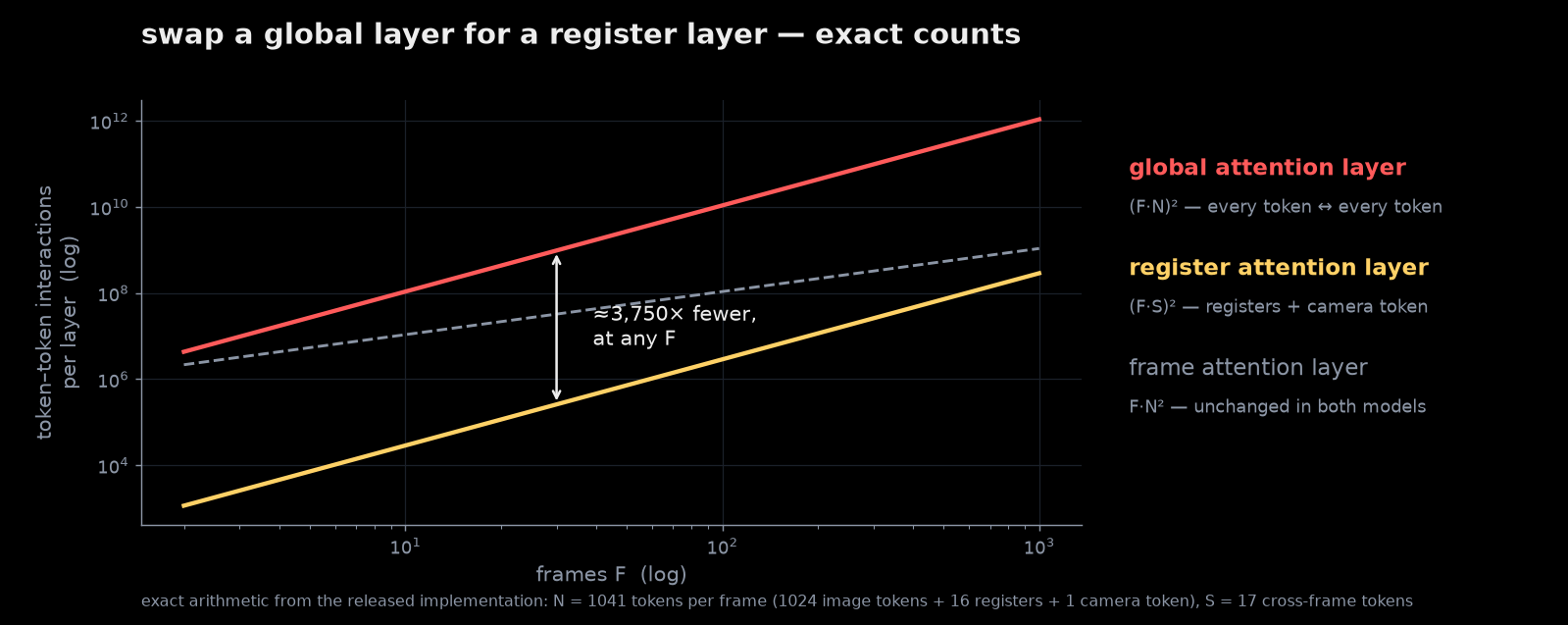
The economics are dramatic because this 17-token courier set is so much smaller than the thousands of image tokens per frame. And the ablations are wonderfully precise about the trade: swapping 25% of the global-attention layers for register attention costs no measurable accuracy while saving about 23% of the backbone's training FLOPs and 16% of its memory. Swap all of them and FLOPs collapse to 6% of the original — a 1000-frame reconstruction drops from 240 seconds to 12 — but accuracy falls back to roughly original-VGGT level. The released model takes the free 25%; the all-register variant is there if you're running on a drone.
Here's the swap in numbers, at VGGT-Ω's released-code token counts: 1,024 image tokens per 512×512 frame, 16 registers, and the camera token included in the register-attention block. Both curves grow quadratically with the number of frames — the register layer is simply about 3,750× lower at every F, because a tiny courier set replaces a thousand-token crowd:
2. One lean dense head instead of many heavy ones. VGGT predicted depth, pointmaps, and tracks each through its own DPT decoder, and the expensive part — high-resolution convolutions — hoarded training memory. VGGT-Ω keeps only the cheap low-resolution DPT layers and replaces the high-resolution blocks with a single MLP plus a pixel-shuffle upsampler. More surprising: it keeps only one dense head, for depth (plus a lightweight camera head that now predicts poses in a single shot — no iterative refinement; the theme of this post runs deep). Pointmaps and tracks aren't predicted at all anymore. They're still supervised — the training loss checks them — but at inference you get pointmaps by simply unprojecting the predicted depth through the predicted cameras. Multi-task losses, not multi-task heads. (They tried going fully convolution-free with MLP-only decoders; it scored fine on benchmarks but produced blocky depth artifacts that humans notice immediately — so the shallow conv layers stayed.)
3. Fifteen times the data — with an assist from the old enemy. The memory savings buy the headline: VGGT-Ω trains on about 4 million scene sequences, 15× more than VGGT. Around 3M come from curated public and internal datasets; the rest were distilled from 40 million raw internet-style videos by a new annotation pipeline — a VLM filters out hopeless clips, an ensemble of matchers finds correspondences, moving objects are masked out, and then, in a twist I love, COLMAP runs bundle adjustment to produce the pseudo-ground-truth labels. The classical optimizer this whole lineage set out to replace is now the teacher, grinding away offline at scale so the network never has to optimize online. (The irony has a face: Johannes Schönberger, COLMAP's creator, is a co-author on the paper.) The pipeline is deliberately conservative — anything ambiguous is thrown away — and its retained labels beat MegaSaM's estimates by a wide margin on Sintel's ground truth.
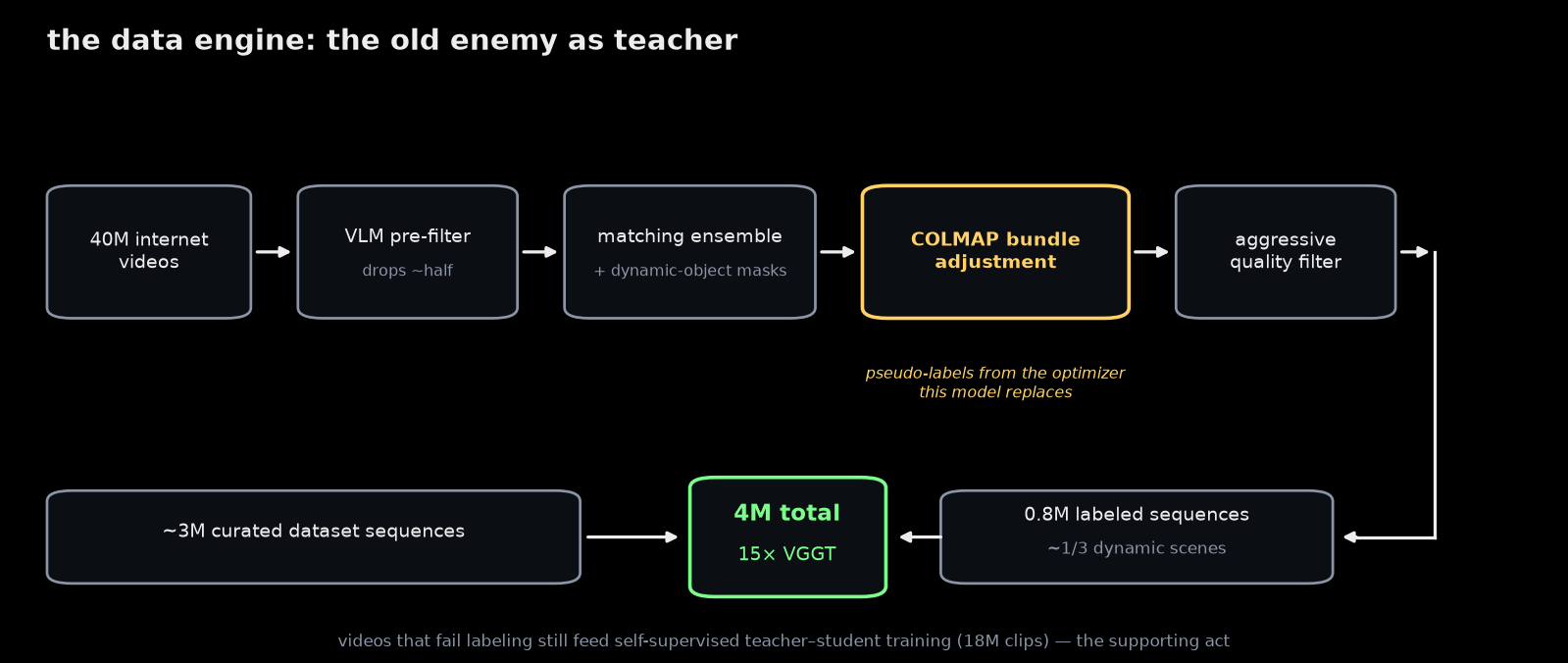
There's also a self-supervised protocol — a DINO-style teacher-student setup that learns from 18 million videos with no labels at all. I expected this to be the headline and it isn't: it nudges the numbers (point error 0.073 → 0.070 in the ablation) and mostly helps out-of-distribution robustness. The authors are refreshingly blunt that self-supervised reconstruction "remains an open problem." The scale story, for now, is the labeled pipeline.
One more source of speed worth naming: the encoder upgraded from DINOv2 to DINOv3, whose larger 16-pixel patches mean ~25% fewer tokens per image before attention even starts. Between that and register attention, VGGT-Ω is meaningfully faster than VGGT at inference — and about 50× faster than MegaSaM, the strongest optimization-based method it's compared against. Memory at inference stays remarkably flat as scenes grow — the released 1B model on a single A100 uses about 6 GB for one frame, 13 GB for 100, and 43 GB for 500 (those are the reported peak-memory figures for the released model, not my measurements). The near-linear growth isn't the registers' doing, though — flash attention never materializes the quadratic attention matrix, so inference memory is dominated by per-frame tensors either way. Registers buy speed; the three moves together buy training memory, and training is where scale lives.
Scaling it — the part that changes the story
Here's why the efficiency matters beyond "it's faster." Once training a reconstruction model looks like training a language model — a clean architecture that eats as much data as you can throw at it — you can ask the question we ask of language models: does it keep getting better as you make it bigger?
It does, and this time there are real numbers to plot. Growing the model from 0.2B to 10B parameters drops the 3D point error from 0.107 to 0.046; growing the training data from two thousand sequences to two million drops it from 0.275 to 0.073. Both curves fall smoothly, power-law-like, with no plateau in sight — the same shape of curve that drove the LLM scale-up, showing up in geometry.
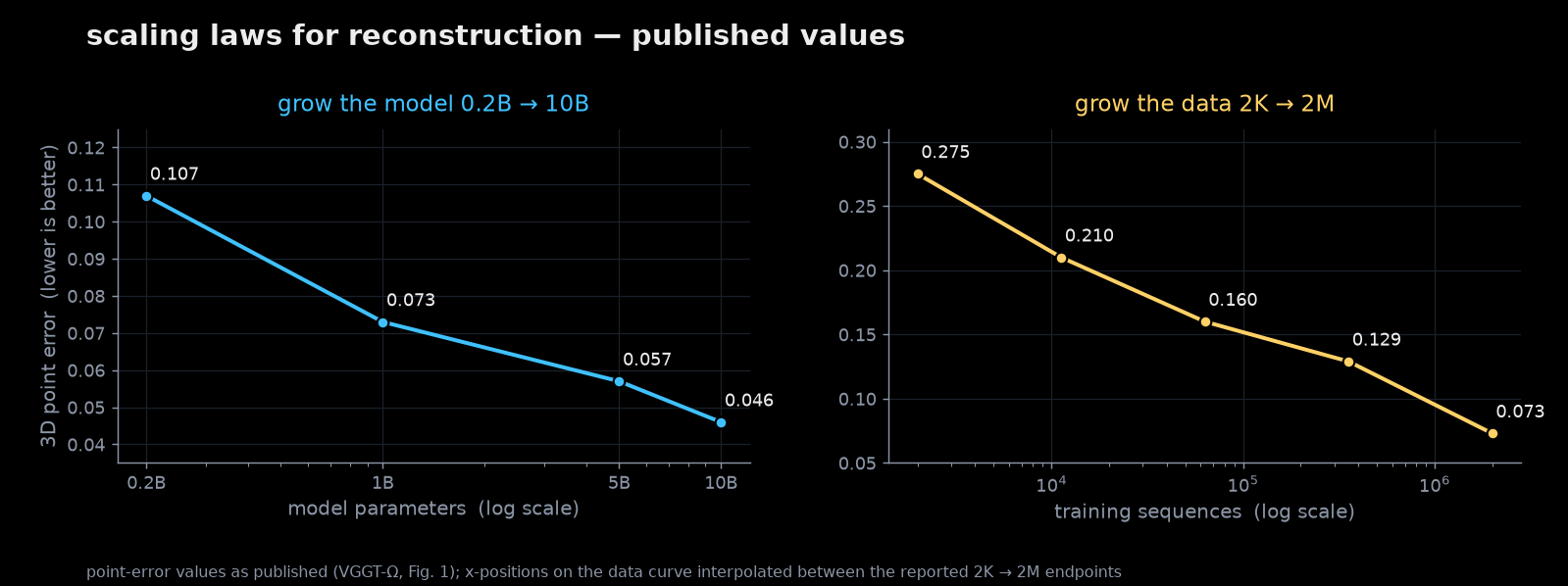
The accuracy lands hard where the field was weakest. VGGT-Ω sets the state of the art on three static and three dynamic benchmarks — dynamic scenes, things moving during capture, were the pointmap lineage's blind spot, and training on real video is what closed it. On the notoriously hard Sintel sequences, camera accuracy (AUC@3°) jumps from the previous best of 22.5 to 40.0 — a 77% relative improvement — over MegaSaM, an optimization-based method, while running 50× faster. Depth accuracy on the same data improves by 26%. And the 10B model beats the 1B everywhere, which is the scaling law doing exactly what it promises.
Where it stands: pros, cons, and where this is headed
Let me lay out the ledger honestly.
What VGGT-Ω is genuinely good at:
- Speed and simplicity — a single forward pass, ~50× faster than the best optimization-based method on dynamic scenes, with no bundle adjustment or global alignment to babysit, and over a thousand frames on one A100.
- Scale — it behaves like a proper foundation model: a clean architecture whose accuracy improves predictably from 0.2B to 10B parameters and from thousands to millions of training scenes.
- Robustness and coverage — because it learned geometry rather than solving for it, it doesn't collapse on textureless walls, repeated structure, or barely-overlapping views the way SfM does, and it handles dynamic scenes, not just static ones.
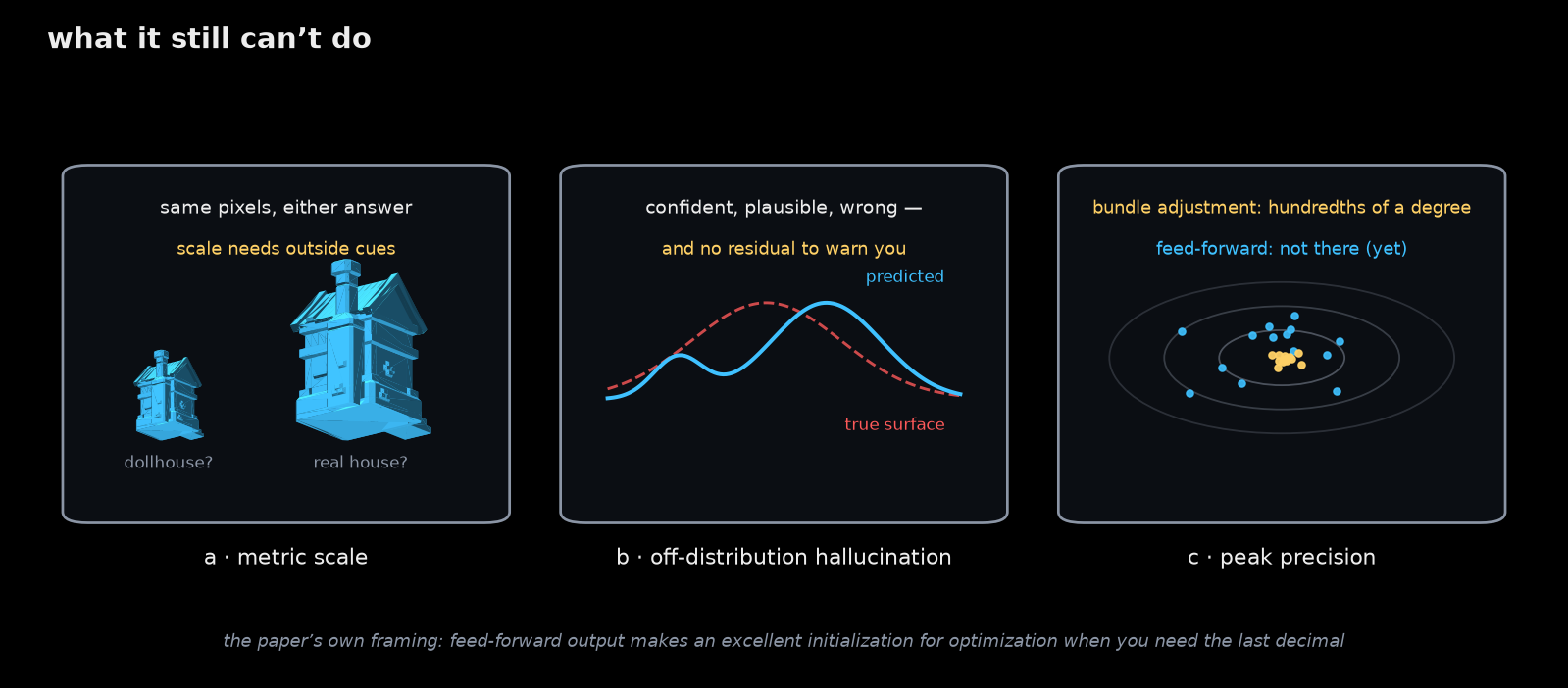
The honest limitations:
- Metric scale is still hard. Like the rest of the pointmap family, absolute real-world scale (is that a dollhouse or a real house?) isn't something a lone image set pins down reliably without extra cues.
- Peak precision still belongs to the optimizer. The paper says so itself: on well-conditioned captures, bundle adjustment reaches angular errors of hundredths of a degree — survey-grade territory feed-forward doesn't touch yet. The authors' own framing is that the two aren't in conflict: a feed-forward pass makes an excellent initialization for optimization when you need that last decimal. And if what you're after is photoreal novel views rather than raw geometry, this output is exactly what a Gaussian-splatting pipeline wants as input.
- It's a learned prior, so it can hallucinate. On scenes far from its training distribution it will still hand you a confident, plausible-looking geometry that may be wrong — with no optimizer residual to warn you the way bundle adjustment's reprojection error would.
- Accuracy was deliberately left on the table. The authors note that task-specific add-ons they chose not to ship — iterative camera refinement, feeding RGB into the depth head — buy another 4–6% on camera accuracy. They prioritized a simple, clean backbone over squeezing the benchmark, betting the community builds on it. The best numbers also come from the 10B model, which is real compute.
Where this is headed. The most interesting results in the paper aren't about reconstruction at all. Those sixteen register tokens per frame — the couriers — turn out to be a compact, transferable spatial representation of the scene. Frozen and bolted onto a vision-language-action model, they lift the LIBERO robot-manipulation benchmark from 97.1% to 98.5% average success. Aligned with a language model CLIP-style, they let text retrieve the right video with 97% top-3 accuracy — the registers, which never see a pixel directly, carry enough scene-level meaning to match natural language. My favorite: cluster the model's internal features on a video of a dancer in a crowd, and one cluster tracks the dancer — motion segmentation nobody asked for, emerging from reconstruction training alone.
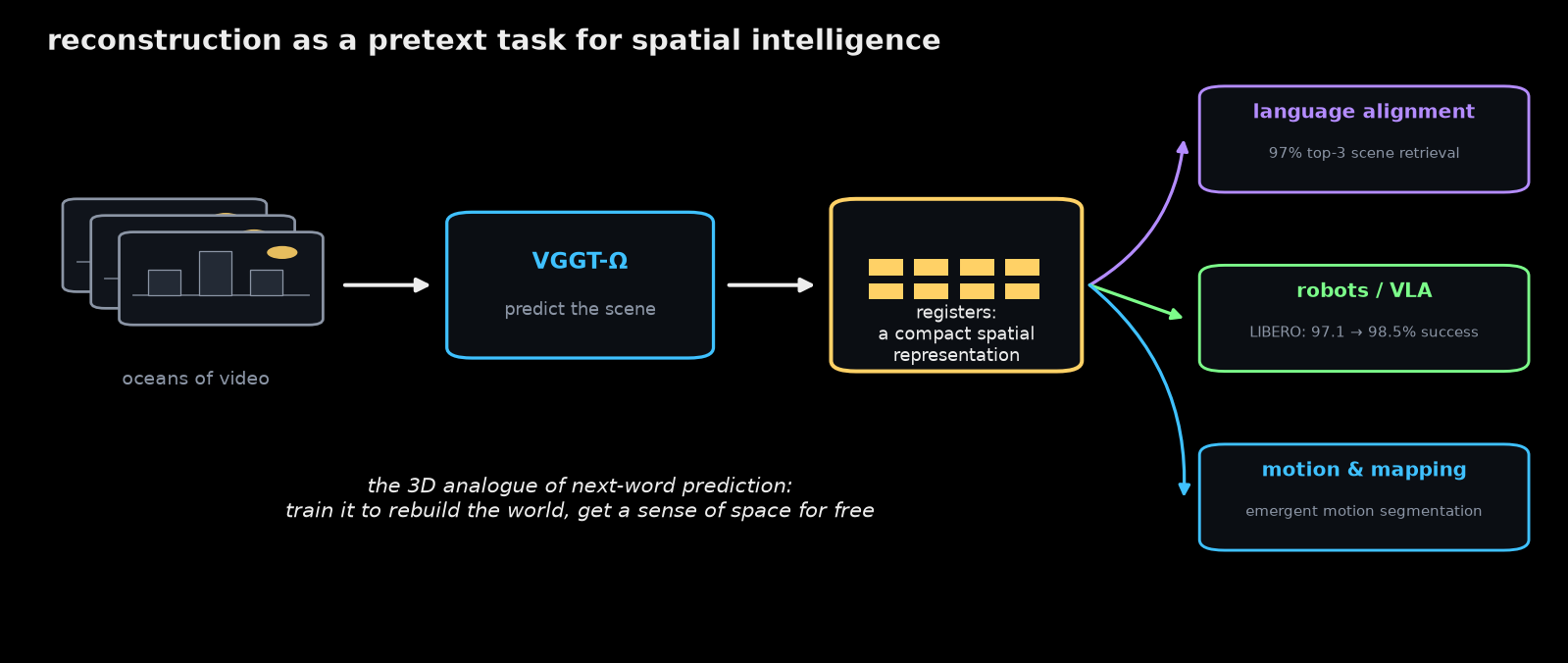
The suggestion is that reconstruction is becoming a pretext task for spatial intelligence: train a model to rebuild the 3D world from video, at scale, and what you get for free is a network that understands space — the missing piece for robots and embodied agents. The authors go a step further and sketch the endgame: reconstruction as one capability inside future unified "omni-models," trained jointly with language and vision, where the geometry resolves what semantics can't and vice versa. The same move that made language models good at everything by training them to predict the next word may be about to happen for 3D, by training models to predict the scene.
That's the arc worth sitting with. In a decade we went from walking away while an optimizer grinds to one forward pass — with the old optimizer's last job being to label the training data for its successor. The forward pass turned out to be the easy part; the real prize is that scaling it teaches the model something like a sense of space.
Sources: VGGT-Ω (arXiv 2605.15195) · project page · VGGT (arXiv 2503.11651) · DUSt3R · MASt3R · COLMAP · facebookresearch/vggt-omega · 3D house model in the figures: KayKit Medieval Hexagon Pack (CC0)